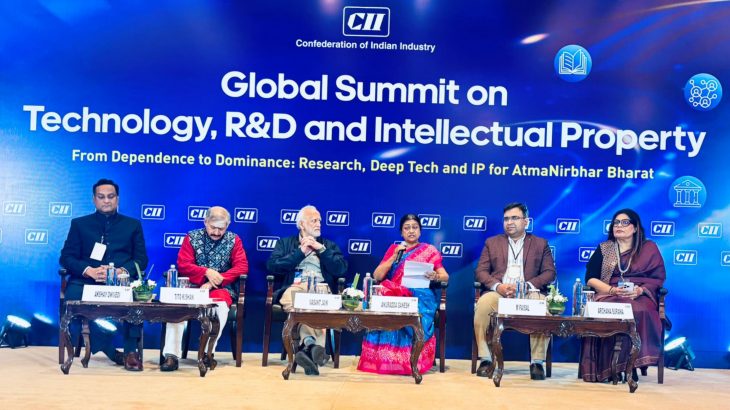
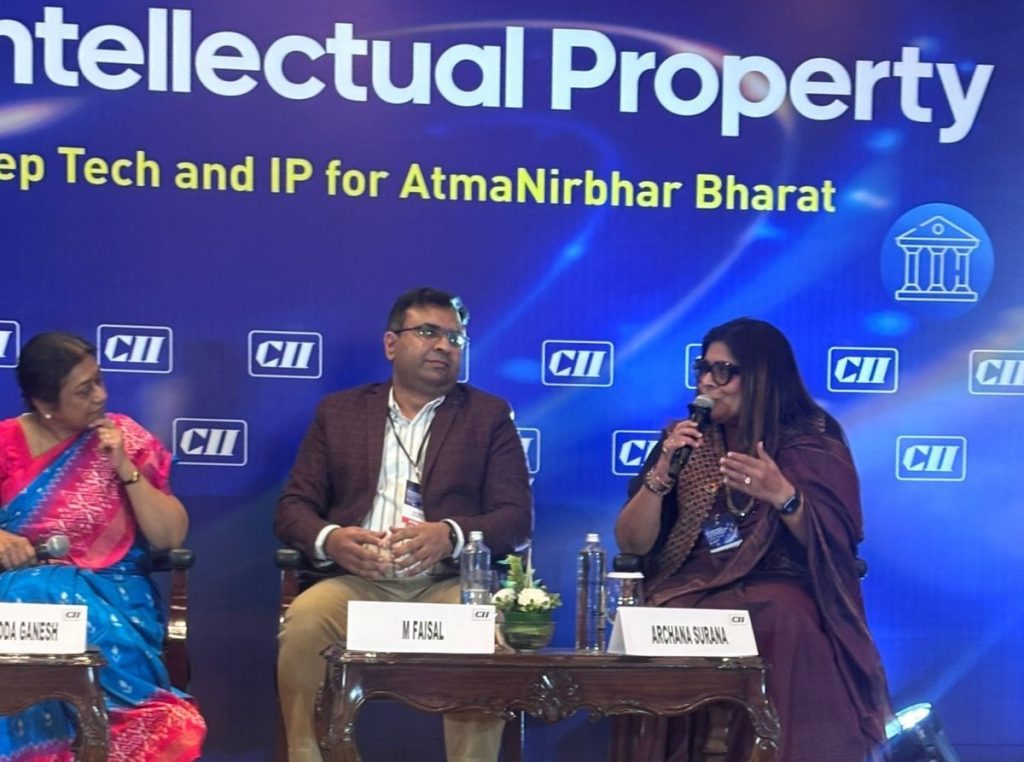
Archana Surana, Founder & Director, ARCH College of Design & Business, spoke at the session titled “Reimagining Industry–Academia Collaboration for a Global R&D and IP Economy” at the CII Global Summit on Technology, R&D & Intellectual Property 2025 in New Delhi. She shared the platform with leaders from ANRF, ProInn, Tata Motors, IIT Roorkee, and C&S Electric, highlighting the role of design-led thinking, interdisciplinary learning, and industry-connected education. Her perspective aligned with NEP 2020, reinforcing the belief that innovation thrives through collaboration between classrooms, companies, and communities.
Technology, AI, Epistemology, and the Work of Nation Building as we enter an economy driven by research, intellectual property, and advanced technologies, we must ask ourselves a fundamental question: are we collaborating to transfer skills or to create knowledge? This is not a rhetorical question. It is an epistemological one.
As India positions itself as a global technology and innovation leader, we must pause and ask a foundational question: are we building technology fast enough, or are we building knowledge deep enough to sustain a nation?
Because technology without epistemic clarity does not build nations. It only accelerates systems—sometimes in the wrong direction. Artificial Intelligence today is not just a tool of automation. It is a producer of content, patterns, and decisions. This fundamentally alters the nature of knowledge.
Epistemology—how we define, validate, and trust knowledge— becomes central to AI-led societies. If data is biased, AI scales bias. If assumptions are flawed, AI industrialises error. Therefore, the future of AI is not a technical question alone. It is a design, ethics, and education question.
Doublethink in AI and Innovation Discourse
George Orwell’s 1984 was not written as a prediction of technology, but as a warning about power over truth. The novel reminds us that the most effective form of control is not surveillance alone, but the internalisation of contradiction—what Orwell called doublethink.
Doublethink is the ability to:
• Know the truth
• And yet accept its opposite
• Without questioning either
In this time, doublethink allows systems to function without ethical resistance.
Here, we encounter modern doublethink. We say AI will democratise opportunity, yet centralise power. We say technology enables creativity, yet reward speed over reflection. We claim innovation drives nation building, yet neglect the human and ecological costs embedded in systems. This is technological doublethink—and it weakens long-term national resilience.

Why This Matters for India’s Nation-Building Agenda
Globally, over 70% of economic value creation now comes from intangible assets—data, design, software, IP, and research.
For India:
• The digital and AI economy is projected to add USD 1 trillion to GDP by 2030
• Yet, less than 20% of higher education outputs currently translate into scalable IP or deep-tech innovation
• AI adoption without contextual design risks job displacement without value creation
Nation building in the AI era requires not just adoption—but authorship. From Technology Consumption to Knowledge Creation, a strong nation does not merely consume technology. It creates frameworks of meaning around it.
This requires a shift in industry–academia collaboration:
• From talent supply chains
• To knowledge and IP ecosystems
Design education plays a critical role here—because design mediates between technology and society. It asks:
• Who does this system serve?
• What behaviours does it shape?
• What futures does it normalise?
NEP 2020, AI, and the Design Imperative
India’s NEP 2020 explicitly calls for research-led education, multidisciplinary, technology integration with ethics, innovation and entrepreneurship as academic outcomes. This positions design education as a national capability, not a peripheral discipline. Design becomes:
• The ethical interface of AI
• The human language of technology
• The bridge between policy, industry, and citizens
ARCH as a Reference Model
At ARCH College of Design & Business, technology and AI are integrated not as tools to replace thinking, but as systems to be questioned, shaped, and responsibly deployed.
Reference indicators include:
• AI-assisted design studios where human judgment remains central
• Research-led final-year projects addressing real industry and societal challenges
• Interdisciplinary integration of design, business strategy, sustainability, and technology
• Strong emphasis on IP literacy, authorship, and ethical accountability
This creates graduates who can work with AI—without surrendering agency to it.
AI, Design, and IP Creation. The AI economy includes:
• Algorithms are intellectual property
• Interfaces are behavioural IP
• Data-informed systems are national assets
ARCH encourages students to see:
• Design outputs as knowledge artefacts
• AI systems as design choices with consequences
• Innovation as a responsibility to society, not just markets
This is critical for building sovereign innovation capacity.
A concrete example of this approach is ARCH’s engagement with the European Union Co-Life project on Impact Focused Enterprenuership. Co-Life demonstrates how:
• Academic research
• Industry mentorship
• Technology-enabled entrepreneurship can converge into impact-focused innovation.
Here, digital tools are used not for speculative growth, but for problem-solving aligned with societal needs and SDGs & Atma-Nirbhar Bharat. This model shows how technology-enabled entrepreneurship can support nation building for a creative economy and not just start-up culture.
At ARCH our ecosystem aligns with Global Alignment and National Purpose:
• NEP 2020 led by research, innovation & entrepreneurship
• Global accreditation frameworks observing planet -centred design & ethics
• United Nations, Social Development Goals, especially:
• SDG 4 – Quality Education
• SDG 9 – Industry, Innovation & Infrastructure
• SDG 11 – Sustainable Communities
• SDG 17 – Partnerships
Technology becomes a means of societal progress, not an end in itself. Time to Resist Doublethink in the AI Era. If we truly want AI to contribute to nation building:
• We must prioritise human intelligence alongside artificial intelligence
• We must reward long-term research over short-term disruption
• We must treat students and educators as co-creators of national intellectual property
Industry–academia collaboration must evolve from: deployment of tools to co-authorship of the future. India’s strength lies in contextual innovation—technology informed by culture, ethics, and lived realities.
By integrating AI with design wisdom, sustainability, and human values, India can lead not by scale alone, but by meaningful innovation. ARCH’s commitment is to nurture designers and innovators who, think critically, design responsibly, use AI consciously, and contribute to nation building through knowledge creation & creative entrepreneurship.
In conclusion, in the age of AI, the real competitive advantage of a nation is clarity of thought. Technology will evolve. Tools will change. But nations are built by those who can question, create, and care.
That is the future we must design—together.