
Introduction
Design education is undergoing a profound transformation. As technology advances rapidly, institutions must evolve to meet the demands of a modern creative industry. The concept of Future of Design Education is no longer theoretical, it is here, reshaping how we teach and learn design. For students in Jaipur and across Rajasthan, recognizing these changes is essential to stay ahead in a competitive world.
Why Design Education Must Evolve
Historically, design education relied heavily on manual sketching, handcrafted models, and traditional ideation methods. These approaches nurtured craftsmanship, aesthetic sense, and material understanding. However, today’s design industry demands a far broader skill set, from digital modelling and interactive experience design to data-driven user research. To remain relevant and effective, design curricula must expand beyond traditional boundaries.
Essential AI Tools for Design Learners (Beginner → Advanced)
To make the most of modern design education, students should gradually build familiarity with a mix of tools — starting from beginner-friendly to advanced, professional-grade. Here’s a roadmap:
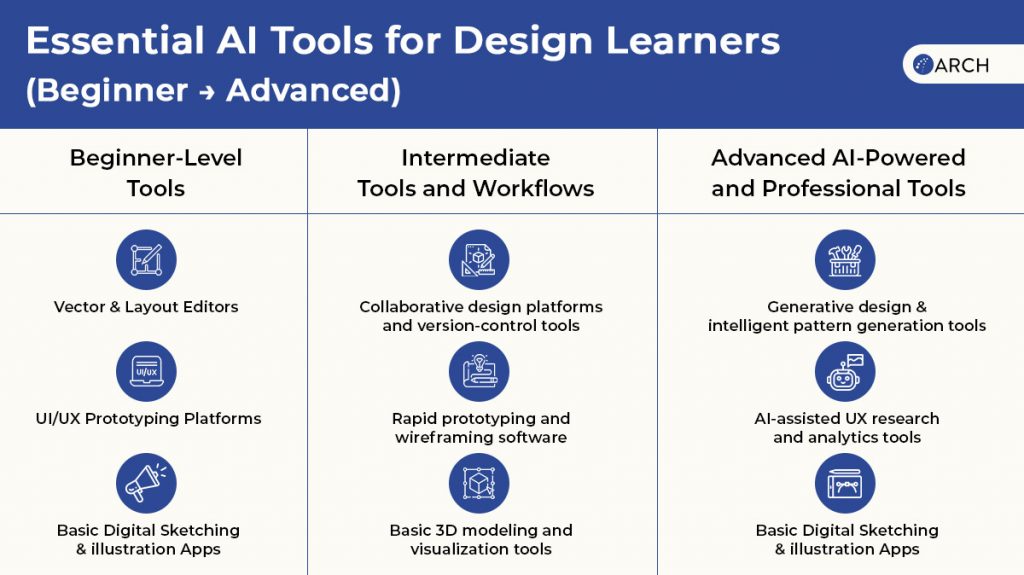
Beginner-Level Tools
- Vector and layout editors — intuitive software that helps learners grasp basics of composition, typography, and layout design. These tools teach foundational design principles without steep learning curves.
- UI/UX prototyping platforms — tools that allow students to mock up interfaces, web pages, or app flows quickly. Beginners learn interaction design fundamentals, user-flow planning, and visual hierarchy.
- Basic digital sketching and illustration apps — many modern apps support stylus/tablet use, enabling students to combine traditional sketching instincts with digital convenience. This helps in preserving core creative skills while embracing technology.
Intermediate Tools and Workflows
- Collaborative design platforms and version-control tools — as design teams become distributed, students must learn collaborative workflows, feedback loops, and project management. These tools simulate real-world design collaborations.
- Rapid prototyping and wireframing software — beyond simple mockups, these enable interactive prototypes, usability testing, and early user feedback. Learners can experiment with user flows, responsiveness, and interface behavior.
- Basic 3D modeling and visualization tools — for product design, interior design or spatial design tracks, introductory 3D tools help students understand form, lighting, materials and spatial relationships.
Advanced AI-Powered and Professional Tools
- Generative design and intelligent pattern generation tools — advanced software that can assist in generating design variations, complex patterns, or even layout suggestions. These tools help designers iterate quickly and explore creative possibilities beyond manual constraints.
- AI-assisted UX research and analytics tools — tools that analyze user interactions, heatmaps, feedback data, or simulate user behavior. These help in bridging design with data-driven decision making.
- High-end 3D rendering and animation software — for advanced students focusing on product design, animation or immersive experiences, professional-grade 3D tools empower realistic visualization, prototyping, and presentation.
By gradually advancing from beginner-friendly software to professional tools, design learners become adept at both creative thinking and technical execution — exactly what the Future of Design Education demands.
Data Points: Evidence of AI’s Rising Role in Indian Education & Design Context
- As of 2025, about 60% of higher education institutions (HEIs) in India permit use of AI tools by students.
- More than 50% of Indian HEIs now use generative AI to develop learning materials, while around 40% deploy AI-powered tutoring systems and chatbots.
- A 2024 survey by a national body found 86% of students are already using AI tools for tasks like summarizing readings, problem-solving and organizing study material — showing widespread AI usage among learners.
- In India’s EdTech and higher-education market, adoption of AI-enabled learning platforms is growing rapidly, aligning with national initiatives to modernize education delivery and make it more accessible across regions.
These data points emphasize that AI and automation are no longer future predictions in India’s education sector, they are already being integrated into classrooms, curricula, and student workflows.
What This Means for Students in Rajasthan and Across India
Aspiring designers from Jaipur and other parts of Rajasthan should look for institutions that embrace modern design pedagogy, combining traditional art fundamentals with digital fluency, user-centered thinking, and technological adaptability. The expanding demand for design professionals nationwide means more opportunities for students who equip themselves with a mix of creativity and tech-savvy. Choosing the right institution now can shape a future-proof career.
For Institutions Offering Top Design Courses in India
Institutions listed among Top Design Courses in India must rethink their curriculum structure, integrating software-based design tools, human-centered design principles, and industry-relevant projects. By doing so, they prepare students for evolving industry standards and enable them to thrive in a tech-driven design environment.
For Institutions Recognized as Best Design Colleges in India
Colleges ranked under Best Design Colleges in India need to invest in faculty training, modern infrastructure, and exposure to cutting-edge design technologies. Emphasising collaboration, real-world design challenges, and interdisciplinary learning helps build a strong foundation for students entering a dynamic design industry.
For Institutions Competing Among Top Design Colleges in India
Design schools vying for position among Top Design Colleges in India should aim to strike a balance, preserving traditional design techniques while embracing digital workflows. This hybrid approach fosters well-rounded designers capable of adapting to changing tools and industry demands without losing core creative values.
Challenges and Important Considerations
While technology offers many advantages, there is a risk that over-reliance on automation may hinder development of manual craftsmanship and original thinking. Students might lean too heavily on shortcuts rather than nurturing foundational skills. Moreover, educators must ensure responsible use of AI tools and maintain academic integrity, originality, and critical thought.
Additionally, integrating these changes demands investment in teacher training, updated infrastructure, and ongoing curriculum upgrades. For institutions in regions like Rajasthan, this may pose challenges but also presents a strategic opportunity to stand out.
Conclusion: Embracing a Forward-Looking Design Education
The Future of Design Education lies at the intersection of creativity, technology, and human empathy. As AI and Automation become integral to learning and design practices, institutions, especially those based in Jaipur and across India, have a unique chance to redefine design education. By blending traditional design sensibilities with modern tools, they can nurture designers who are not just artists, but innovators, thinkers, and social contributors.
For students and educators alike, adapting to this shift is not just advisable, it’s imperative. The next generation of designers must be equipped to thrive in a world where technology and human creativity coexist harmoniously.