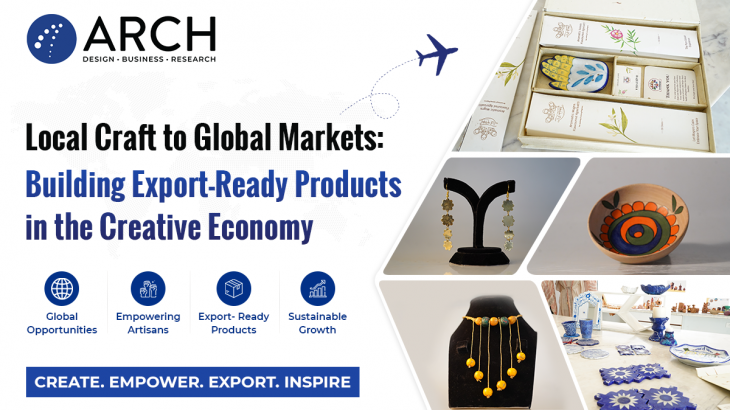
India’s artisan communities have always been creators. Every woven textile, handcrafted basket, embroidered fabric, ceramic object, or carved wooden artefact carries within it generations of knowledge, cultural memory, craftsmanship, and identity. These are not merely products—they are expressions of creativity and living heritage.
The strongest way to position the craft creations is to move beyond “how to export products” and situate SHGs within the larger Creative Economy, where value is created not merely through manufacturing but through creativity, culture, heritage, innovation, and intellectual capital. This framing is increasingly adopted by UNESCO, UNCTAD, WIPO, and governments worldwide.
Today, the world is increasingly recognizing that creativity itself is an economic resource. This has given rise to what is known as the Creative Economy, an economy in which ideas, culture, design, innovation, craftsmanship, storytelling, and intellectual property generate livelihoods, enterprise, and sustainable development.
For Self-Help Groups (SHGs), this presents a significant opportunity. They are no longer simply producers of handmade goods; they are contributors to India’s creative economy, where local knowledge and cultural traditions become drivers of employment, entrepreneurship, exports, and inclusive growth.
In this new economy, the value of a product is determined not only by the material used to make it, but by the story it tells, the culture it represents, the quality it demonstrates, the innovation it embodies, and the positive impact it creates. A handcrafted product that reflects authenticity, sustainability, and thoughtful design often commands a far greater value than a mass-produced alternative.
Export readiness, therefore, is not merely about selling products overseas. It is about transforming creativity into economic value while preserving cultural identity and strengthening community livelihoods.
The Creative Economy Begins with Creativity
Every artisan possesses a creative asset—the ability to transform local materials, indigenous knowledge, and traditional skills into products that are unique and meaningful. Unlike factory-made goods, handcrafted products carry a human story that cannot be replicated by machines.
The challenge is to translate this creative value into market value. Design plays a crucial role in this transformation. It helps artisans understand changing lifestyles, emerging consumer preferences, global trends, and new applications for traditional crafts without compromising their authenticity.
Creativity becomes most powerful when it solves contemporary needs while preserving cultural heritage.
Design as a Value Multiplier
Design is often misunderstood as decoration. In reality, design is a process of problem-solving that improves functionality, usability, aesthetics, sustainability, and market relevance.
A traditional weaving technique can become contemporary home furnishings. A bamboo basket can evolve into a premium office organiser. Indigenous embroidery can be reimagined as luxury fashion accessories. Pottery can become modern tableware suited for international homes.
The craft remains the same; its application expands.
This ability to innovate while respecting tradition is one of the defining strengths of the creative economy.
Culture Creates Competitive Advantage
Global consumers increasingly seek products with authenticity rather than uniformity. They are interested in knowing who made a product, where it came from, and the traditions it represents.
This is where India’s artisan communities possess an extraordinary advantage. Every region carries distinctive cultural narratives, materials, motifs, colours, and techniques that cannot be copied elsewhere.
Rather than competing through low prices, artisans can compete through originality, craftsmanship, cultural richness, and meaningful storytelling.
In the creative economy, authenticity is one of the strongest forms of competitive advantage.
From Handmade to High Value
The journey from local markets to international markets requires a shift in mindset.
Artisans are not simply making products, they are creating brands, building intellectual property, preserving cultural heritage, generating employment, empowering women, supporting rural economies, and contributing to India’s soft power across the world.
Every improvement in quality, packaging, branding, sustainability, certification, traceability, and customer experience increases both the economic and cultural value of the product.
This is how creativity becomes enterprise.
Creative Economy and Sustainable Development
The creative economy contributes directly to sustainable development by generating local employment, encouraging entrepreneurship, reducing migration, preserving traditional knowledge, empowering women-led enterprises, promoting environmentally responsible production, and strengthening community resilience.
For SHGs, creativity is therefore not only a source of income but also a pathway towards dignity, inclusion, and long-term prosperity.
Conclusion
India stands at a unique moment where its cultural diversity, traditional craftsmanship, and entrepreneurial spirit can together shape a globally competitive creative economy. Self-Help Groups have an essential role to play in this transformation.
By combining traditional knowledge with contemporary design, international quality standards, sustainable production, strong branding, digital visibility, and export readiness, artisans can create products that are valued not only for what they are made of but for what they represent.
The future of exports lies not in producing more, but in creating greater value. Every handcrafted product has the potential to become an ambassador of India’s culture, creativity, and innovation.
SHGs can strengthen their product aspiration or export potential by adopting practices such as:
- Using natural or recycled materials
- Minimising plastic packaging
- Reducing production waste
- Conserving water and energy
- Using natural dyes where feasible
- Supporting fair livelihoods for artisans
Before sending a product to an international buyer or a high end customer every artisan should ask:
- Would I confidently purchase or sell this product myself?
- Would I proudly gift it to someone?
- Can it survive international shipping?
- Does it tell an authentic story?
- Does it reflect the quality expected by a global customer?
If the answer is “yes” to each of these questions, the product is well on its way to becoming export ready.
When creativity meets quality, culture meets commerce, and tradition embraces innovation, artisans do not simply enter international markets, they help build a resilient, inclusive, and globally recognized creative economy.
This framing elevates the discussion from technical export training or market ready to a strategic understanding of the creative economy, aligning it with Atmanirbhar Bharat & UNESCO’s vision of culture as a driver of sustainable development and positioning SHGs as creators of economic, social, and cultural value rather than merely producers of goods. It also aligns closely with the philosophy of design-led development and impact-focused entrepreneurship that ARCH has consistently championed.