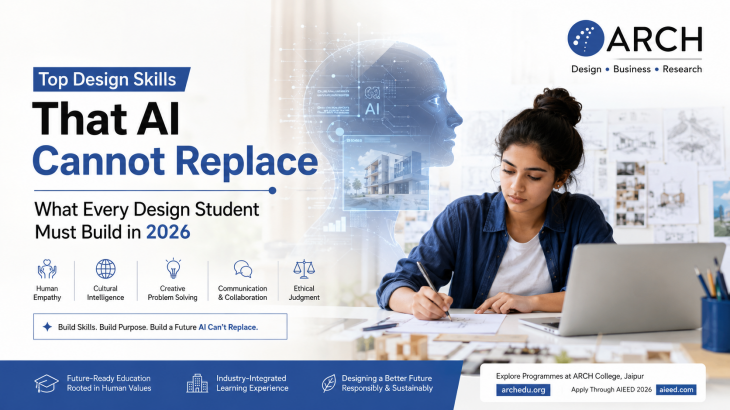
The top design skills that AI cannot replace include human empathy, cultural intelligence, creative storytelling, material sensibility, design thinking, client communication, and ethical judgment. These are skills built through experience, education, and human interaction, and they are precisely what every design student must develop to build a resilient, future-ready career in 2026 and beyond.
The Real Conversation Design Students Need to Have About AI
There is a conversation happening in every design classroom, every student group, and every family dinner table across India right now. It goes something like this:
“AI can already generate images, create logos, and design interiors in seconds. So what exactly is left for human designers to do?”
It is a reasonable question, and it deserves a serious answer. Not a dismissive one, and not a fearful one. A clear, honest, informed answer.
Here it is: AI is an extraordinarily capable tool. But it is a tool. It does not understand people. It does not feel like a culture. It cannot negotiate ambiguity, hold a client’s hand through a difficult brief, or make a judgment call that requires empathy, ethics, and lived experience, all at once.
The top design skills that define great designers are precisely the ones AI cannot automate. And building those skills, deliberately and deeply, is what design education in 2026 must be about.
Human Empathy and User-Centred Thinking
Empathy is the foundation of every design discipline. Before a designer sketches a single line, they must understand who they are designing for, what that person feels, fears, desires, and needs in their specific cultural and social context.
AI can analyse user data. It can identify patterns in behaviour and generate outputs based on statistical probability. But it cannot sit with a user, listen to them, watch them interact with a product, and understand the gap between what they say they want and what they actually need.
This is the core of human-centred design, and it is a fundamentally human skill. Students who develop the ability to listen deeply, observe carefully, and design with genuine empathy for the end user will always be more valuable than any tool that produces outputs without understanding people.
Cultural Intelligence and Contextual Sensitivity
India is one of the most culturally complex nations in the world. A Fashion Design graduate working on a bridal collection for a Rajasthani client, a Jewellery Design student creating pieces rooted in Jaipur’s gem-cutting traditions, or a Graphic Design professional building a brand identity for a regional food company, all of them require a depth of cultural understanding that no algorithm can replicate.
AI is trained on data. Data reflects what has already been created. Cultural intelligence is the ability to understand what a community values, how it communicates, what it considers sacred, and how design can honour and elevate those values, not just reference them superficially.
Students who invest in building genuine cultural knowledge, through travel, research, community engagement, and exposure to India’s extraordinary creative heritage, develop a skill that is both irreplaceable and commercially valuable.
Design Thinking and Creative Problem Solving
Design thinking is a structured approach to solving complex problems through empathy, ideation, prototyping, and testing. It is the methodology that allows designers to tackle challenges that have no obvious or pre-existing solution.
AI is exceptional at optimising within a defined problem space. It cannot reframe the problem itself. It cannot look at a failing product and ask: “What if we are solving the wrong problem entirely?”
That reframing ability, the capacity to question assumptions, look at a situation from an unexpected angle, and generate entirely new approaches, is what design thinking develops. It is also, increasingly, what every industry in India is looking for, not just creative industries.
Whether a student pursues Interior Design, Product Design, or a business programme with design integration, design thinking is the most transferable and future-proof intellectual skill they can build.
Material Sensibility and Craft Knowledge
There are dimensions of design that exist entirely in the physical world, such as how a fabric drapes, how a piece of jewellery sits on the skin, how the grain of a wood panel responds to light, how a product feels in the hand when its weight is perfectly calibrated.
These are sensory, material judgments that come from years of working with real materials in real conditions. A Fashion Design student who has spent hours understanding textiles, their weave, their weight, their response to dye and heat, carries knowledge in their hands and eyes that no AI can replicate.
The same is true for Interior Design, where the judgment of how materials behave together in a space, acoustically, thermally, visually, requires direct physical experience. And for Product Design, where the tactile quality of an object is often the difference between a product people love and one they discard.
This embodied, material knowledge is one of the most durable and irreplaceable assets a designer can build.
Client Communication and Relationship Management
Design is a service, and at the heart of every design project is a human relationship. Between the designer and the client. Between the designer and the manufacturer. Between the designer and the end user.
Managing these relationships requires communication skills, emotional intelligence, negotiation ability, and the capacity to translate between the language of creativity and the language of business. These are profoundly human capabilities.
A skilled designer can sit across from a client who cannot articulate what they want, ask the right questions, interpret the silences, and build a creative response that feels exactly right. No AI can do that.
Students who develop strong communication skills, written, verbal, and visual, alongside their design craft will always have a professional edge that technology cannot erode.
Ethical Judgment and Responsible Design
The most important design decisions in the coming decade will not be aesthetic ones. They will be ethical ones.
What materials should we use? What impact does this product have on the environment? Is this communication honest? Does this interior serve the people who will actually live in it, or just the client who commissioned it?
Ethical judgment, the ability to weigh competing values, consider long-term consequences, and make decisions that reflect genuine responsibility, is a human capability. It develops through education, reflection, exposure to diverse perspectives, and the cultivation of a personal value system.
Institutions like ARCH College, which build principles of sustainable, human-centred, and ecologically responsible design into their curriculum, are specifically developing this capacity in their students. And in a world where AI can generate anything, the designer who knows what should and should not be made is invaluable.
Building These Skills at the Right Institution
Knowing which skills matter is the first step. The second step is choosing an education that genuinely builds them.
The best design colleges in India do not just teach students to use tools, whether those tools are traditional or AI-powered. They build the foundational human capacities that make designers irreplaceable: empathy, cultural knowledge, design thinking, material craft, communication, and ethical judgment.
For students who want to combine these design capabilities with business strategy and leadership skills, an AI Integrated BBA Course that bridges design thinking with management and technology prepares graduates to operate at the intersection of creativity and commerce, one of the most in-demand professional profiles in India today. Students looking for a program that goes further can also explore a BBA with AI for Business, which directly addresses how technology, data, and human creativity work together in modern organizations.
ARCH College of Design and Business, Jaipur, established in 2000 and recognised with the Times Business Award for Institutional Excellence in Design Education, builds all of these skills across its B.Des programmes in Fashion Design, Graphic Design, Product Design, Interior Design, Jewellery Design, Communication Design, Digital Design, Photography, and its BBA in Business Design and Entrepreneurship. Grounded in the philosophy of Empower, Co-Create, and Innovate, ARCH’s curriculum is designed for the world as it is today, and as it will be tomorrow.
Conclusion – Build What AI Cannot Copy
The students who will lead India’s creative economy in the next twenty years are not those who feared AI or ignored it. They are the ones who understood it clearly, used it as a tool, and invested their real energy in building the skills it cannot replicate.
Empathy. Cultural intelligence. Creative problem solving. Material craft. Communication. Ethical judgment.
These are the top design skills of the AI era. And they are built – not downloaded.
Explore design programmes at ARCH College, Jaipur → archedu.org
Apply through AIEED 2026 → aieed.com